Built in the Rainforest: A Railway from 1891, a Cableway from 1995 and a Spanish Castle at Mena Creek
Updated September 24, 2026 · 8 min read
If you come to Cairns looking for old streets you will be disappointed within an hour. Most of what stands in the town is younger than the people visiting. The built things worth a day here are all outside it, and they have one thing in common: each was an argument with a mountain range.
The railway that took five years and killed men nobody counted
The Cairns–Kuranda line exists because tin was found at Herberton in 1879, and because the rain here makes roads pointless. In the wet season the packhorse tracks up to the Tablelands turned to mud and the fields behind the range were cut off. The answer was a railway, and the range it had to climb is the one you can see from the Esplanade.
Construction began in 1886 and reached Kuranda in 1891. The numbers are the reason to go:
- 15 tunnels, cut by hand, and 37 bridges
- 37 km of track, climbing from sea level to 328 metres
- three million cubic metres of earth excavated, largely with picks, shovels and black powder
- passenger services from 25 June 1891
Men died building it. How many is not recorded anywhere you can check, and that absence is itself the story — this was not a project that counted its labour carefully, and the work was done by hand on a ledge above a gorge.
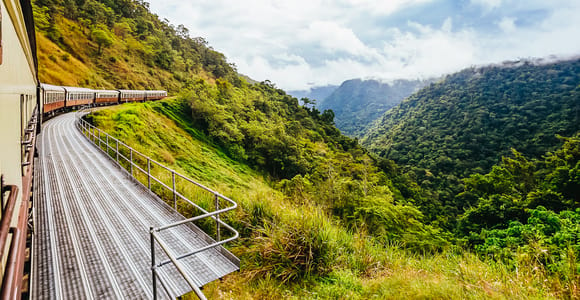
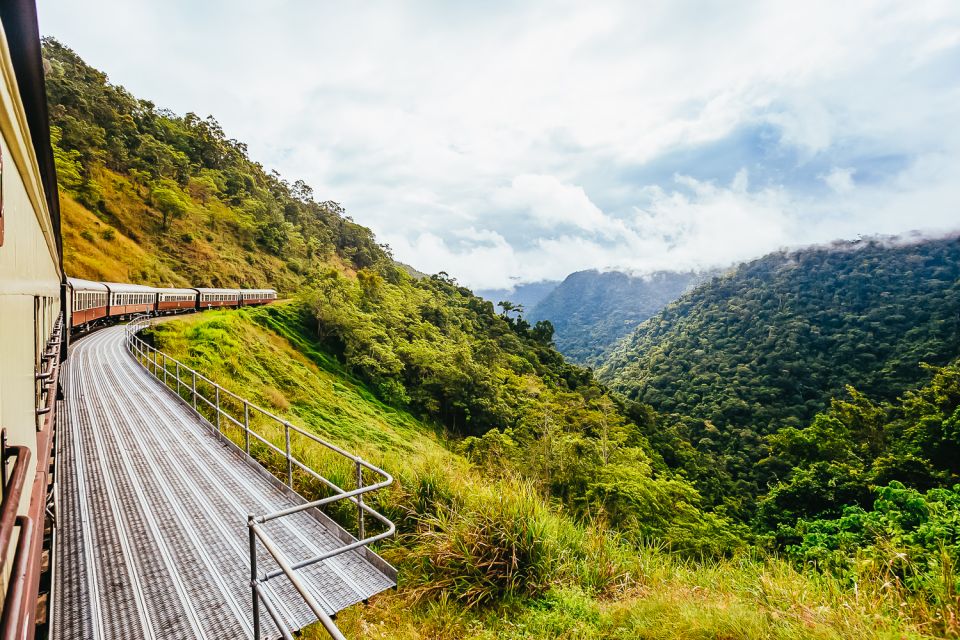
What you see from the carriage is the result: the track clings to the side of the Barron Gorge, and at Stoney Creek the line crosses a curved steel bridge directly beneath a waterfall. The train stops at Barron Falls so you can get out, which in the dry season means a modest fall on a big rock face and in February means something you feel through your feet.
The cableway that was built from the air
The Skyrail Rainforest Cableway opened on 31 August 1995 and runs 7.5 km over the same range, above the canopy rather than through it. It has 32 towers, the tallest 40.5 metres, and it stops twice — at Red Peak, 545 metres up, and again above Barron Falls.
The detail that makes it more interesting than a chairlift is how it got there. A road to each tower would have cut a strip through World Heritage rainforest wider than the cableway itself, so there is no road. The towers were flown in. Heavy-lift helicopters carried them in sections, some weighing five tonnes, onto sites cleared to ten metres by ten — and 900 tonnes of steel and cement went up to Red Peak the same way.
Whether that is remarkable or merely expensive is a fair question, and the gondola answers it: the corridor under the cable is not a cleared line. You are looking down at a canopy that closes over again between the towers, which is the whole point.
Doing both in one day, and the version with a car
Almost nobody rides the railway twice. The standard day is one up, one down, and it is genuinely better in that order — the train climbs slowly with commentary, and the gondola descends quietly over what you have just come through.
The self-guided version with train and Skyrail is €117.49 and takes about 7 hours, with 4.6 stars from 3,601 reviews — the second most-reviewed listing on this site, behind one reef cruise. It includes transfers and leaves you free time in Kuranda village, which is a market town and not a heritage site; treat it as lunch rather than a destination.
Check the Skyrail operating day before you plan this, because 2026 is not a normal year for it. Upgrade works from 19 August to 1 November 2026 have the cableway running a shortened Kuranda–Barron Falls loop rather than the full Smithfield run, and it is open Wednesday to Sunday only — closed Mondays and Tuesdays. Times and availability are limited for that stretch. A train-up-Skyrail-down day still works outside those dates; inside them, read what the booking page is actually selling you.
If you are driving yourself, the combo ticket without transfers is €80.39 for the same two rides over about 5 hours. The catch is obvious once you think about it: your car ends up at whichever end you did not finish at. The Skyrail terminal at Smithfield and the station in Cairns are not the same place, and the shuttle between them is what the €37 difference buys you.
There are 25 Kuranda railway and Skyrail options from €15 in the local listings, and most of them are the same two rides in different combinations.
A Spanish castle, poured in concrete, by a cane cutter
Two hours south of Cairns, at Mena Creek, there is a ruin that no guidebook prepares you for.
José Paronella arrived from Catalonia in 1913 and cut sugar cane. He bought 13 acres of rainforest beside Mena Creek Falls in 1929 for £120 and spent six years building on it — a castle, a ballroom, tunnels, bridges, fountains, staircases down to the falls, and 7,500 trees planted around the lot. He did it in poured reinforced concrete, largely by hand, and he opened it to the public in 1935 as a pleasure garden with a cinema and a dance floor.
The part that stops people is the hydro plant. He harnessed the falls to run the lights, and it was commissioned in 1933 — the first privately owned hydroelectric plant in Queensland. The town around him had no mains power.
Cyclones, floods and a fire have worked on it since. What you visit is a ruin, not a restored building, and anyone selling it as a castle experience is overselling. Moss on concrete, a grand staircase going down to brown water, a tunnel, and a story about one man’s fixed idea. It is better than that sounds, and it is the strangest built thing in Far North Queensland.
The entry ticket is €36.48 with 4.8 stars from 95 reviews. The day tour that combines it with Lake Barrine and Millaa Millaa Falls is €142.22 and runs 10 hours, 4.7 stars from 149 reviews.
Ten hours is a real number and a long day. Mena Creek is 120 km from Cairns, the coach stops elsewhere on the way, and this is the point at which it is worth comparing hire cars for Cairns: the Bruce Highway south is straightforward, the Tablelands loop back is the good part, and a car turns a fixed 10-hour itinerary into your own. Australia drives on the left, and the roads up the range are narrow and slow — but none of this needs four-wheel drive.
There are 25 Atherton Tablelands and waterfall trips from €22 if you would rather be driven.
What is actually in the city
Not much, and the honest version is short. The Cairns Museum is at 105 Lake Street with the entrance on Shields Street, and an entry ticket is €9.28 — the cheapest bookable thing on this site, and a reasonable hour when it rains.
There is also a 90-minute history walking tour at €32.74. It carries 5 stars, but from 7 reviews — that is a new listing, not a verdict, and worth reading the recent ones before booking. The 12 city sightseeing options from €10 are among the smallest categories on this site, which tells you where this place keeps its value: outside town, in two World Heritage areas.
If you do one built thing
Take the train up and the Skyrail down. One climbs through the gorge and the other floats over it, and doing both is the only way to see what the 1886 surveyors were up against.
Then, if the weather has broken and a rainforest day appeals more than a reef day, drive south to Mena Creek and look at what a cane cutter built out of concrete in six years, because nobody told him it was a strange thing to do.