Outer Reef, Inner Reef or an Island? Choosing a Reef Day from Cairns
Updated September 24, 2026 · 8 min read
There are 61 bookable reef trips from Cairns, starting at €97, and from a list of names they look like the same day at six price points. They are not. The real fork in the road is how far offshore you go, and everything else — the cost, the coral, the crowd and whether you enjoy it — follows from that one decision.
The three kinds of reef day
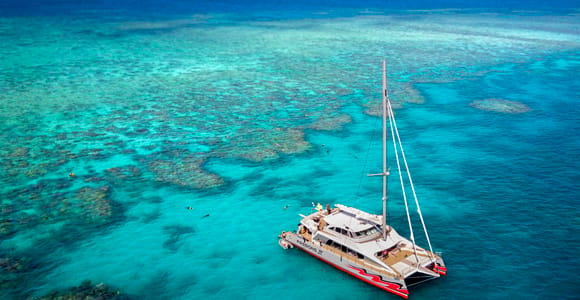
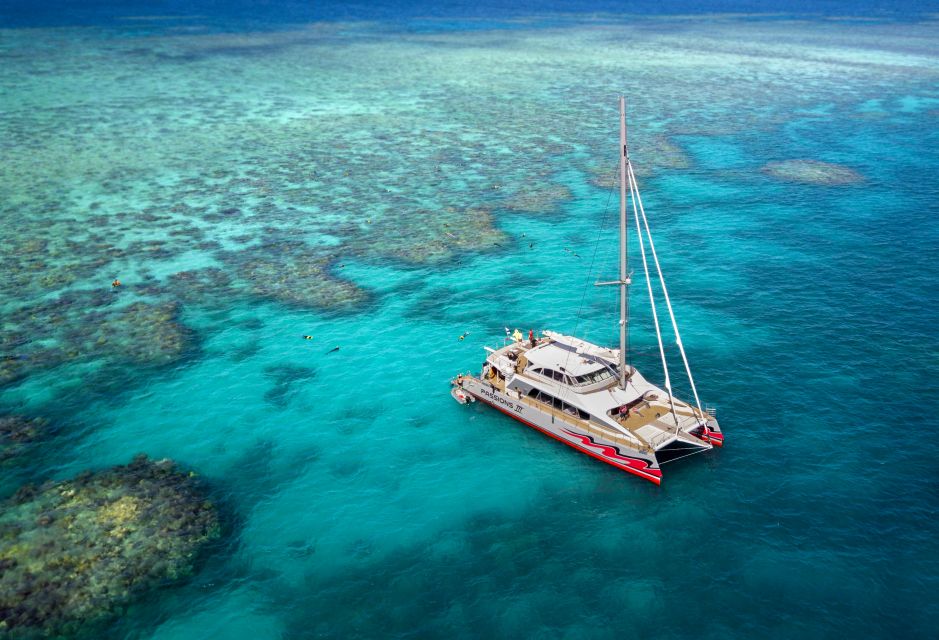
The outer reef. Roughly 90 minutes each way by fast catamaran, across open water. This is the reef people picture: coral bommies in deep blue, visibility that makes the postcards, and water you cannot see the bottom of. It is also the long version of the day — the big catamaran trip runs nine hours — and about three of those are spent moving, the first ninety minutes of them before you see any coral at all.
The inner reef, via an island. Green Island and Fitzroy Island both sit around 45 minutes out. The coral is fringing reef — shallower, patchier, closer to shore — and the day is shorter, cheaper and far calmer. There are 25 island day trips from €65.
The pontoon day. A permanently moored platform at an outer reef site, with a dry deck, a semi-submersible, a glass-bottom boat and usually lunch. It is the most expensive form and the one that asks least of you. If somebody in the group does not swim, this is the version that still gives them a day.
Green Island and Fitzroy Island are not interchangeable
They get sold as a pair and they are opposites.
Green Island is a coral cay — a low sand island that the reef itself built. It is flat, it is small, and the rainforest boardwalk that crosses it is a 1.3 km return walk that Queensland Parks puts at 30 minutes — flat, step-free, and described by the park service as suitable for a wheelchair with assistance, which is worth confirming with your operator rather than taking from here. You can step off the jetty and be snorkelling in a few minutes.
Fitzroy Island is a continental island — a granite mountain that the sea rose around. Its walking tracks are climbs rather than strolls, and they are two separate routes: Lighthouse Road is 3.6 km return and Queensland Parks allows two hours for it, while the Summit track is 4 km return, allow three hours, and rises over boulders and steps to 269 metres. There is a turtle rehabilitation centre on the island as well. The beach is coral rubble, not sand, which surprises people who booked it expecting the postcard.
Neither is better. But if you have a pushchair and a three-year-old, one of them is flat and one of them is a mountain, and no booking page tells you that.
Seasickness is the thing that actually ruins reef days
Not the price, not the coral. The crossing.
The run to the outer reef leaves the shelter of the coast and crosses open sea, and it is the part of the trip that gets described as “90 minutes” and never as “90 minutes of swell”. If anyone in your group is prone to it, the honest options are these: take the morning departure, sit low and midships rather than up top or at the bow, keep your eyes on the horizon rather than on a phone, and eat something plain beforehand rather than nothing.
If it is a known problem rather than a worry, the answer is the inner reef, not a stronger stomach. You get coral, you get a swim, and the water between you and it is sheltered. And anything beyond the practical advice above belongs to a pharmacist or a doctor before you travel, not to a travel page.
What the ticket does and does not include
Two things are worth checking on the booking page rather than assuming.
The reef tax. Every commercial trip into the Marine Park collects an environmental management charge per person, which goes to the Reef Authority rather than to the operator. Most listings build it into the displayed price; some collect it on board. Ask which, because it is the most common reason a “€97” day costs more than €97 at the counter. The current rate is published by the Reef Authority itself — take it from there or from your confirmation, not from a blog.
Stinger suits. From November to May the water off this coast is in marine stinger season, and operators hand out full-body lycra suits. That is not upselling and it is not optional gear; it is the season for box jellyfish and Irukandji. Confirm the suit is included rather than hired, and confirm they have your child’s size.
What you will actually see down there
The reef has been through a lot in recent years, and the useful answer is neither “it’s dead” nor a brochure.
The Australian Institute of Marine Science surveys the same reefs every year. In its 2025/26 report, average hard coral cover in the northern Great Barrier Reef rose from 30.0 % to 35.1 %, and in the central region from 28.6 % to 31.6 %, while the southern region slipped slightly from 26.9 % to 26.4 %. That is recovery following the 2024 mass bleaching, and it comes with a caveat the institute states plainly: bleaching, floods, cyclones and crown-of-thorns starfish all continue to press on the reef, and the swings over the past fifteen years have been large.
What that means for your day: coral cover varies enormously between sites, and the site matters more than the operator. Ask which reef the boat goes to, by name. A good crew will tell you, and will tell you what it looked like last week.
Which one to book
If you want the version this town is known for, the premium catamaran day to the outer reef is €170.05, runs nine hours, and holds 4.8 stars across 3,866 reviews. Nine hours is the honest number — that is a full day, gone.
If nine hours is more than your group has in it, the shorter reef trips exist and they are not a lesser version of the same thing, they are a different day: less travel, less coral, more time on land.
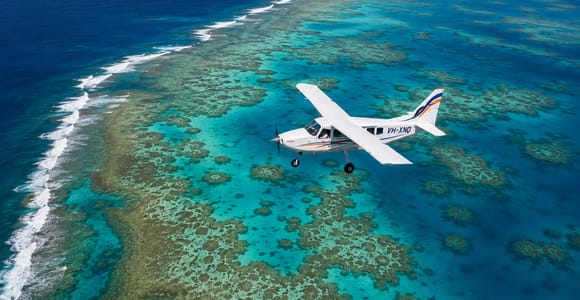
And if nobody in the party swims, there is a third answer that people forget. There are 19 scenic flights from €124, and a reef seen from the air — the ribbon reefs, the sand cays, the colour change where the shelf drops away — is a sight the boats cannot give you. It is a half hour rather than a day, and for some travellers it is the better half hour.
One last piece of timing
Book the reef for the first usable day of your stay, not the last. Trips get cancelled for wind, and a cancelled trip on your final morning is a refund rather than a reef. Everything else here — the rainforest, the Tablelands, the town — runs whatever the sea is doing.