Snorkelling the Great Barrier Reef from Cairns: What You Actually See, and Who Should Not Go
Updated September 24, 2026 · 7 min read
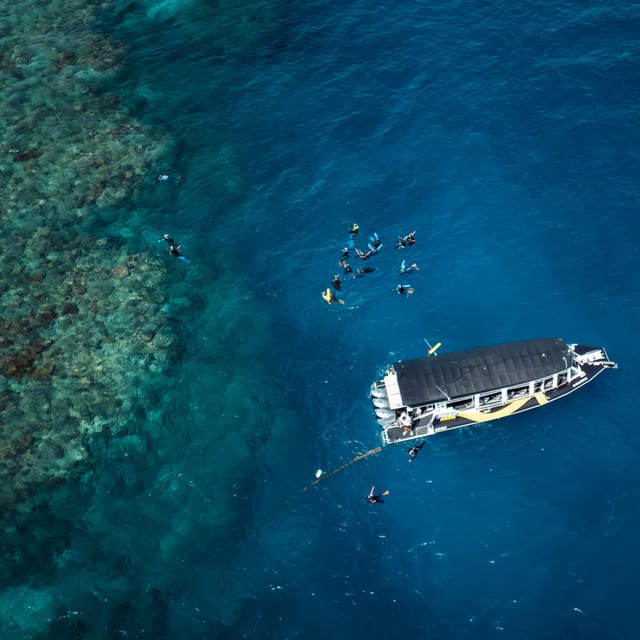
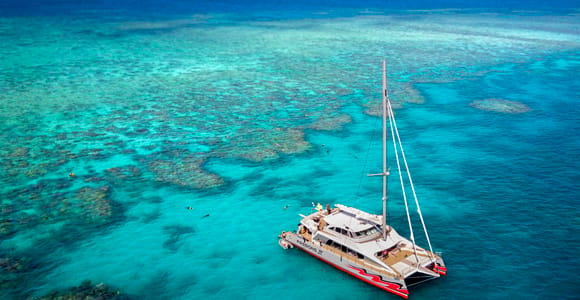
Snorkelling is the reason most people come to Cairns, and it is also the activity most often booked on the thinnest information. The listings all say coral, fish and turtles. None of them say which reef, how long you are in the water, or who should probably not get in.
Half day or full day, and what the difference buys
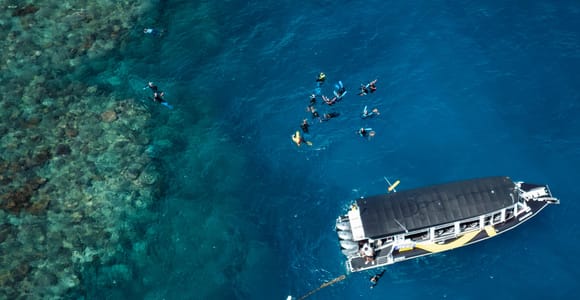
A half-day trip puts you at a closer mooring and has you back for the afternoon. The half-day snorkelling trip is €110.69 for four hours, with 4.7 stars from 1,917 reviews, and it runs small-group with a guide in the water rather than a headcount at the ladder.
A full day goes further out, stops at two or three sites instead of one, feeds you, and takes eight to nine hours. More coral, more travel, and a boat you cannot leave when you have had enough.
The honest rule: the extra hours buy you sites, not snorkelling time. You will be in the water for roughly the same total on either — an hour here, an hour there — because that is how long most people last. What the long day gives you is variety and the chance that one of the stops is exceptional.
There are 61 reef trips from Cairns starting at €97 and they divide along this line before any other.
The question that decides your day
Ask which reef the boat moors at, by name.
Coral condition varies more between two sites twenty minutes apart than it does between two operators. A crew that names its moorings — and tells you what they looked like last week — is a crew that goes to sites worth naming. A booking page that says only “the Outer Reef” is telling you it does not matter to them which one.
This is also the answer to the question everyone actually wants to ask, which is whether there is anything left down there. The Australian Institute of Marine Science surveys the same reefs every year. Its 2025/26 report found average hard coral cover in the northern Great Barrier Reef up from 30.0 % to 35.1 %, and in the central region from 28.6 % to 31.6 %, with the southern region slipping from 26.9 % to 26.4 %. That is recovery after the 2024 mass bleaching — and the institute is equally clear that bleaching, floods, cyclones and crown-of-thorns starfish keep pressing, and that the swings of the past fifteen years have been large.
So: not a graveyard, not a brochure, and very much dependent on the site.
The stinger suit is not an upsell
From November to May the water off this coast is in marine stinger season. Box jellyfish and Irukandji are both present in the period, and operators hand out full-body lycra suits as standard.
Three things follow:
- Wear it. It is not optional gear and the crew will not treat it as a preference.
- Check whether it is included or hired, because on some listings it is a line item.
- Check they carry your child’s size, and say the size at booking. A suit that does not fit is not protection.
Outside those months the suits are still worth wearing for sun alone. An hour face-down over a reef is an hour with the back of your legs pointed at the tropics.
Who should think twice
Nobody says this on a booking page, so it is worth saying here.
If you cannot swim, book a boat that has an alternative. Glass-bottom boat, semi-submersible, pontoon deck — several trips carry one, and on those you get a reef day without getting out of your depth. A flotation vest plus open water is not a substitute for being able to swim, whatever the listing implies.
If you are prone to seasickness, the outer reef is 90 minutes of open water each way. The inner reef around Green Island and Fitzroy Island, reachable in about 45 minutes with 25 island trips from €65, is the sheltered version of the same day. Practical measures help — morning departure, sitting low and midships, eyes on the horizon — and anything beyond that is a conversation with a pharmacist or doctor before you fly, not with a travel page.
If you burn easily, the reef is a bad place to find out. The water magnifies nothing and forgives nothing; shade on the boat is limited and the deck is bright.
Small things that improve the hour
Get in first. The best visibility of the day is usually in the first ten minutes at a mooring, before fifty pairs of fins have stirred the sand.
Do not chase. Turtles surface on their own schedule and swimming at one guarantees it leaves. Stay still over a bommie for two minutes and more happens than in twenty minutes of paddling around.
Nothing gets touched, standing included. Standing on coral kills it, and it is also how people cut their feet badly. Every crew says this in the briefing and it is repeated here because it is the single rule that matters.
Prescription lenses exist. Several operators carry optical masks in common strengths. If you wear glasses, ask before you sail rather than snorkelling a blur.
Booking it at the right point in the week
Book the reef for the first usable day of your stay, not the last. Wind cancels trips, and the whole point of an early booking is that a cancellation still leaves you a second chance later in the week.
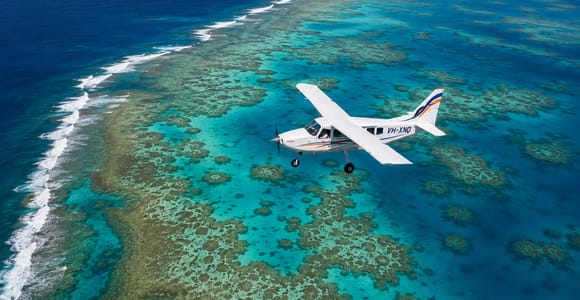
And if the sea is closed out for your whole stay, the reef is still visible from above — 19 scenic flights from €124 go up when the boats stay in. It is not snorkelling. It is the difference between having seen the reef and not.