Wildlife Around Cairns: Crocodiles, Cassowaries and the Water You Do Not Go Into
Updated September 24, 2026 · 7 min read
Far North Queensland has the animals people come to Australia for, and it has one of them living in the rivers you drive past. Both halves of that sentence matter, and only one of them is in the brochures.
Croc country is a legal status, not a mood
Estuarine crocodiles — the big ones, often called saltwater crocodiles although they live in fresh water too — are present across this region’s rivers, estuaries and coastal waters. Queensland’s Be Crocwise guidance is short and worth reading before you travel rather than at a boat ramp:
- Never swim in water where crocodiles may live, even if there is no warning sign.
- Obey crocodile warning signs. In protected areas, swimming or standing in water above knee height near a warning sign, or where estuarine crocodiles are frequently seen, is an offence.
- Stand back from the water’s edge when fishing, and do not stand on logs or branches overhanging water.
- Never clean fish or discard scraps near the water’s edge, at campsites or at boat ramps.
- Keep arms and legs inside the boat.
- Stay well back from slide marks on a bank.
The Daintree River, which almost every northern day trip crosses, holds large estuarine crocodiles. Nobody local swims in it. The absence of a sign is not the absence of a crocodile.
The safe swimming in this region is in specific places: the filtered, patrolled Esplanade Lagoon in the city, netted beaches north of town in stinger season, and the freshwater swimming holes in the Tablelands that are signposted as such. If you are unsure about a waterhole, the answer is no.
Seeing them properly: cruise or park
A river cruise is the honest version — wild animals on their own river, at their own scale, from a boat that keeps a distance. Daintree River wildlife cruises run around an hour, and the good ones are as much about birds, snakes and the forest edge as about crocodiles. You may see a big one; you may see a two-metre one on a mudbank and a lot of kingfishers. That is what wild means. There are 11 river and dinner cruises from €19 in the local listings.
A wildlife park is the reliable version, and there is no shame in it. You will see a large crocodile at close range, and you will see the other animals people have flown a long way for — koalas, wombats, kangaroos, cassowaries, snakes — in one afternoon.
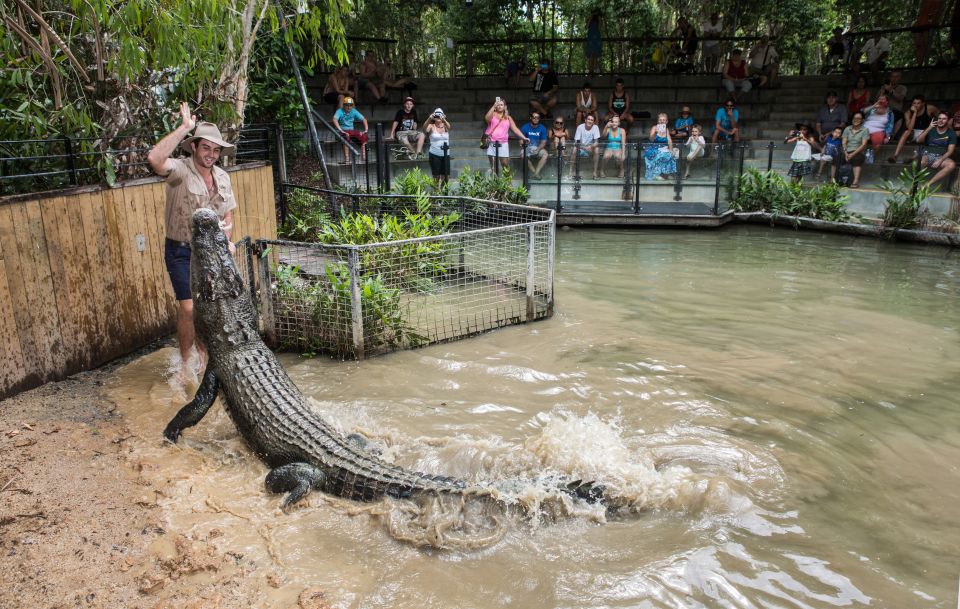
Hartley’s Crocodile Adventures sits 40 km north of Cairns, about 40 minutes up the highway and halfway to Port Douglas, which is why most visitors book it with transport rather than adding a drive to the day. The afternoon visit with return transfers is €80.39 for five and a half hours, with 4.7 stars from 475 reviews, and includes the park’s wetland cruise and its crocodile and snake presentations.
Be clear with yourself about what the presentations are: the crocodile feeding is a show. It is staged, it happens on a schedule, and the animal is fed to make it move. That is not a criticism — it is how anyone gets to watch a crocodile launch out of water without being in it — but it is different from a river cruise, and children sometimes need that said out loud beforehand.
There are 35 wildlife and crocodile park options from €13 in total, which includes the city aquarium for a wet afternoon.
The bird you should actually be careful around
Everyone worries about crocodiles and nobody worries about cassowaries, and in terms of day-to-day encounters that is backwards.
Southern cassowaries live in the rainforest here — heavy, flightless, up to human height, with a helmet-like casque and a serious clawed foot. They turn up on the road and at car parks in the Daintree and around Mission Beach, particularly where people have fed them before.
The rules are simple and they are the opposite of instinct: do not feed them, do not approach for a photograph, and if one comes towards you, put something solid — a tree, a vehicle — between you and it and back away rather than running. Feeding is what turns a shy forest bird into one that walks up to cars, and that is how both cassowaries and people get hurt.
Turtles, and where you can actually see them
Green and hawksbill turtles are common on the reef, and most snorkellers see one. Two things help: stay still rather than swimming after them, and ask the crew where they have been surfacing, because it is usually the same corner of a mooring.
On Fitzroy Island there is a turtle rehabilitation centre, which is a different kind of visit — rescued animals, an explanation of what put them there, and a fixed visiting arrangement rather than a walk-in. Check the times before you build an afternoon around it.
What the season changes
The wet season, roughly December to March, is when the rainforest is at its loudest and the waterfalls are full — and it is also when crocodiles are most active and rivers run high and dirty. Warning signs matter more, not less, in the months when the water moves.
The dry, roughly May to October, is easier for everything: cooler mornings, clearer water on the reef, and better odds on the river cruises because the animals bask in the sun on the banks.
Neither season is a bad time to see animals here. They just reward different days.
If you do one wildlife thing
Take the river cruise and accept that you might see very little. It is an hour, it costs less than most things here, and it is the only version where the animal is not there for you.
Then, if the children want a guaranteed crocodile at ten metres, book the park — and tell them beforehand which one was the real thing.